

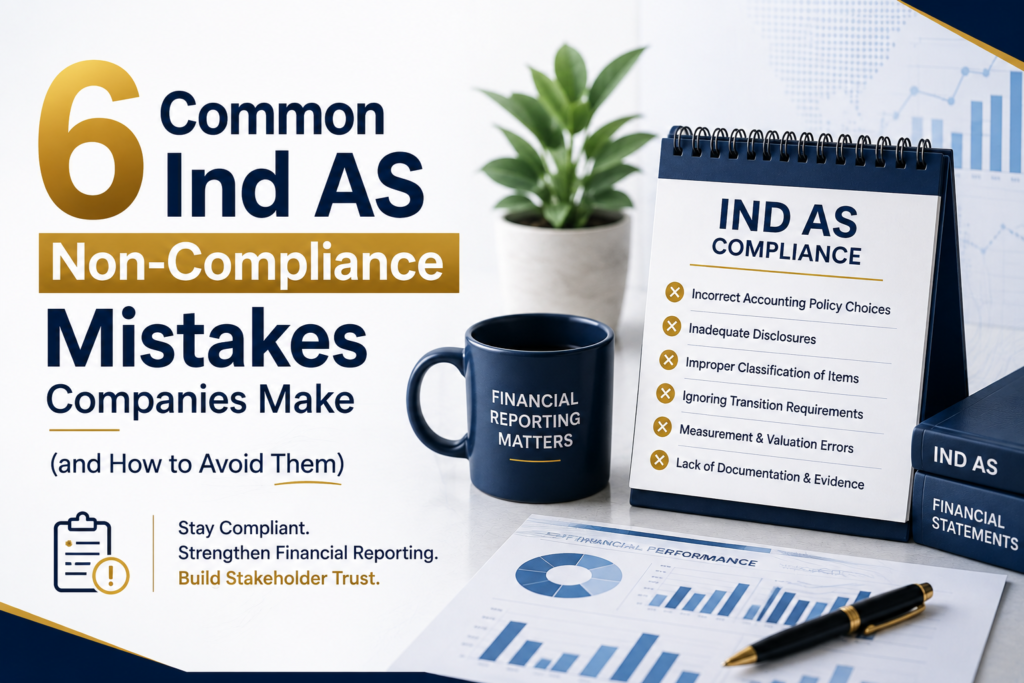
Ind AS non-compliance is not limited to incorrect accounting entries. Companies can get into trouble by misclassifying financial instruments, recognising revenue at the wrong time, mismeasuring leases or impairment, calculating deferred tax incorrectly or missing required Ind AS disclosures.
This article covers six common Ind AS compliance mistakes across Ind AS 109, 115, 116, 36, 12 and 16, explains why they happen in India and shows how finance departments can identify and fix them before entering non-compliance red zone.
With years of experience advising businesses on Ind AS matters, Master Brains brings a practical perspective to the accounting, Ind AS implementation and compliance challenges companies face under Ind AS.
Ind AS non-compliance occurs when a company misinterprets transaction substance, uses improper measurement basis or fails to provide required disclosures under Indian Accounting Standards.
Compared with Indian GAAP, Ind AS places greater emphasis on economic substance, fair value measurement, management estimates and detailed Ind AS disclosures.
Complete Ind AS guide: applicability & standards
Ind AS are notified by the Ministry of Corporate Affairs (MCA) under the Companies Act, 2013, while ICAI provides the Ind AS compendium and related implementation guidance.
Transitioning to Ind AS creates company-wide operational changes. After discovering Ind AS Applicability, compliance is another challenging step.
We keep seeing the same three fundamental issues:
Teams may learn Ind AS rules but continue thinking in the old way focusing on legal form rather than economic substance. Ind AS requires a deeper assessment of what a transaction actually represents.
Many standard ERP platforms are not configured with Ind AS, e.g. not able to calculate amortized costs via the Effective Interest Rate (EIR). As a result, finance teams depend upon Excel spreadsheets, introducing manual error risks into financial reporting.
An auditor’s job is to independently evaluate the financial statements. But the auditor is not a substitute for the company’s own Ind AS review, accounting controls or Ind AS implementation process. It is a mistake to depend on them to flag Ind AS mistakes and help fix it along the way. However, an experienced Ind AS consultant can support your company while taking responsibility as a part of your own extended finance team.

| Ind AS Standard | Common Mistake | Quick Fix |
| Ind AS 109 & 32: Financial Instruments | Incorrect classification, SPPI assessment or ECL provisioning. | Review contractual terms, business model, SPPI assessment, complete customer profile for ECL. |
| Ind AS 115: Revenue | Incorrect performance obligations, revenue timing – contract liabilities, variable consideration. | Examine customer contracts, performance obligations, transaction price and contract liabilities. |
| Ind AS 116: Leases | Incorrect lease term, discount rate, lease liability or modification accounting. | Review lease terms, renewal options, ROU assets, lease liabilities and modifications. |
| Ind AS 36: Impairment | Incorrect CGU identification and missing reversal of impairment loss. | Assess CGUs, add corporate assets to the appropriate CGU and test impairment indicators. |
| Ind AS 12: Income Taxes | Missing temporary differences in specialised transactions or incorrect tax effects in OCI/equity. | Carefully calculate temporary differences and tax effects in OCI/Equity. |
| Ind AS 16: PPE | Incorrect capitalisation, component accounting and missing decommissioning cost. | Identify asset components, decommissioning expenditure, useful lives and residual values. |
Incorrect classification of financial instruments without analyzing the underlying contract is one of the biggest mistakes in corporate finance.
Conduct a legal contract review of all hybrid debt instruments, preference shares and intercompany agreements against Ind AS 32 and Ind AS 109 classification criteria. Update your ECL provision matrix to include current economic conditions and risk profiles alongside historical default rates.
Ind AS 115 uses a 5-step model to recognize revenue. The biggest issue is when companies bundle distinct products and services together or misjudge when control passes to the customer.
Review major customer contracts to correctly identify performance obligations, determine when control transfers and allocate the transaction price appropriately. Rebates, returns, discounts and contract modifications should be taken into account before recognising revenue.
Ind AS 116 brings non-exempted leases on the balance sheet as Right-of-Use (ROU) Assets and Lease Liabilities. However, errors happen after the initial setup.
Review lease contracts thoroughly for certain renewal/termination options, use of appropriate discount rate based on availability and reassess the lease liability whenever terms are modified.
Maintain a central lease register with controls for renewals, rent changes, extensions and modifications to update ROU assets and lease liabilities on time as per Ind AS 116 Accounting.
The purpose of Ind AS 36 is that your assets are not carried at a value higher than what they can actually recover through use or sale.
Perform CGU assessment. Corporate assets must be allocated to the appropriate CGUs on a reasonable and consistent basis. At each reporting date, reassess indicators of impairment and reversal, while keeping in mind that goodwill impairment is never reversed.
Ind AS 12 follows the balance sheet approach, meaning deferred tax is recognised based on temporary differences between the carrying amount of an asset or liability and its tax base. Grave Ind AS mistakes happen when companies fail to trace the tax impact of special transactions.
Companies should carefully calculate temporary differences, including those arising from leases and recognise DTA only when future taxable profits are reasonably supported. Tax effects related to OCI or equity should also be recorded in the same place as the underlying transaction.
Ind AS 16 dictates the recognition, measurement and depreciation of tangible assets such as machinery, buildings and factories.
Companies should identify significant components separately, correctly recognise decommissioning provision and use appropriate useful lives, residual values and depreciation methods. These estimates should also be reviewed regularly to ensure the PPE carrying amount is accurate and compliant with Ind AS 16.
Ind AS 117: Insurance Contracts applicability and accounting principles
The most common mistakes include incorrect opening balance-sheet adjustments, wrong classification of financial instruments, improper use of Ind AS 101 exemptions and incomplete transition disclosures. Companies may also fail to identify all required adjustments from previous GAAP to Ind AS.
Revenue recognition frequently gets wrong because companies fail to properly identify performance obligations, determine the transaction price, allocate consideration and assess when control transfers to the customer. Complex contracts and variable consideration have higher risk of errors.
Companies often miss or inadequately present disclosures relating to significant accounting judgements, estimates, financial instruments, related parties, revenue, leases and deferred tax. In many cases, the accounting is correct but the required disclosure is incomplete.
Yes, auditors can qualify financial statements for material Ind AS non-compliance under SA 705 if management doesn’t correct it. Statutory auditor can issue an audit report with a qualified opinion or adverse opinion as per SA 705, depending on the nature and pervasiveness of the misstatement.
Companies can conduct an Ind AS health check covering Ind AS recognition, measurement, presentation and disclosures. Reviewing high-risk areas such as revenue, financial instruments, leases, deferred tax, PPE and related-party transactions can identify issues before the statutory audit.
An independent Ind AS health-check gives the finance team an objective view of accounting gaps before they become big issues. It helps identify non-compliance, weak documentation, incorrect estimates and disclosure gaps early. It reduces surprises, audit adjustments and compliance risk. Most importantly, it gives management a clear & actionable roadmap to Ind AS reporting.
There is no single penalty for Ind AS non-compliance. Under Section 129 (7) of the Companies Act 2013, penalty of up to ₹ 5 lakh and/or imprisonment up to one year can be imposed on responsible officers. If the conduct involves fraud, Section 447 can impose imprisonment of 6 months to 10 years and a fine of 1-3 times the amount involved, subject to other conditions. Listed companies can face SEBI actions.
Yes, Ind AS can apply to private and unlisted companies with net worth of ₹ 250 crore or more. It also applies to their holding, subsidiary, associate and joint-venture companies.
The real Ind AS non-compliance gaps usually hide in small accounting details.
At Master Brains, our Ind AS review is solid. We examine accounting policies, recognition and measurement, estimates, calculations, disclosures and supporting documentation to identify potential gaps.
Our Ind AS compliance health-check and review services help finance teams strengthen financial reporting, improve Ind AS disclosures and documentation and deal with technical accounting issues.
Connect with Master Brains for an independent Ind AS health check.
CA Neha Agarwal, Founder of Master Brains, is a Chartered Accountant with experience in Ind AS compliance, Ind AS health checkup and Ind AS accounting advisory. Through Master Brains, she works with businesses on Ind AS accounting and compliance matters, helping finance teams comply with complex accounting requirements.

Master Brains is a consultancy firm based in Delhi having associate partners including Chartered Accountants, Company Secretaries, Cost Accountants, Investment Bankers, Registered Valuers and other consultants in the field of Finance, Tax and Law, PAN India.


Chartered Accountant and Founder of Master Brains. Experience in Direct Taxes (Agarwal Sanjay and Associates, Delhi) and Indirect Taxes (Deloitte India, Bangalore).
LinkedIn Profile