

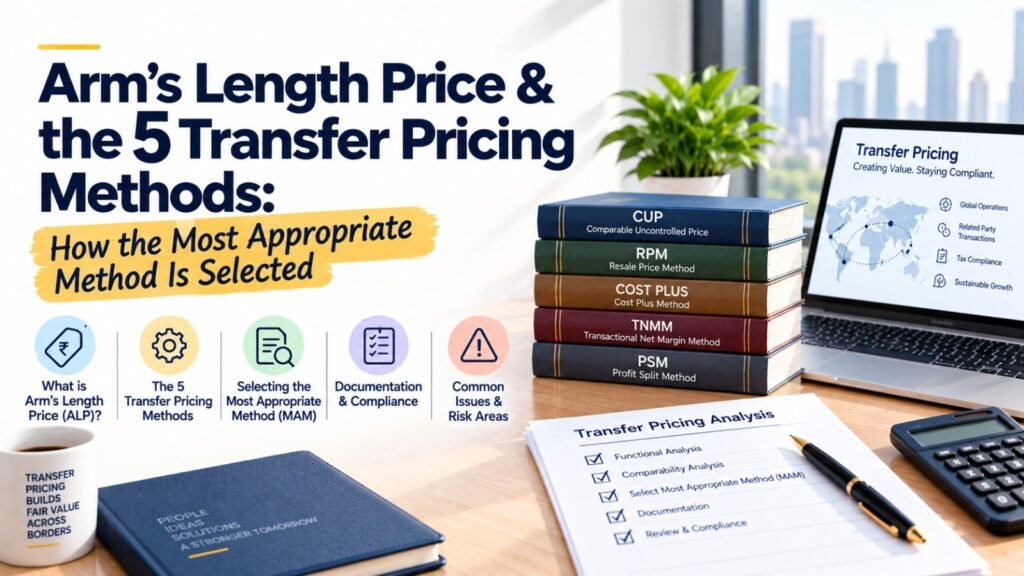
Under Section 92C(1) of the Income Tax Act, 1961, five transfer pricing methods are prescribed to determine arm’s length price, Comparable Uncontrolled Price (CUP), Resale Price Method (RPM), Cost Plus Method (CPM), Profit Split Method (PSM), and Transactional Net Margin Method (TNMM), along with an ‘other method’, as prescribed by CBDT (Central Board of Direct Taxes).
If your company does business with a related party abroad, whether that’s buying raw materials from a parent company, charging a subsidiary for services, or lending money to a group entity, every one of those transactions has to be priced as if the two of you were strangers. That is the core idea behind arm’s length price. And India’s transfer pricing regulations under the Income Tax Act, 1961 make it mandatory.
But knowing that arm’s length pricing applies is only half the problem. The harder question is which of the five prescribed transfer pricing methods you use to benchmark that price. And whether you can defend that choice if a Transfer Pricing Officer (TPO) disagrees.

That defense starts with method selection. Get it wrong, and your entire transaction falls apart under scrutiny. And once your method is selected and your benchmarking is done, all of it gets reported in a single statutory document, Form 3CEB. This is the report your Chartered Accountant certifies and files with the Income Tax Department, confirming that your international transactions were priced at arm’s length. Missing its deadline is not an option.
Here is something most people get confused about: the Form 3CEB deadline is not a fixed calendar date that the government announces every year. It is calculated.
Under Section 139(1) of the Income Tax Act, companies that have entered into international transactions or Specified Domestic Transactions (SDTs) with associated enterprises get an extended ITR filing deadline. That deadline is 30th November of the Assessment Year, for FY 2025-26, that is 30th November 2026.
Form 3CEB under Section 92E has a simple rule attached to it which must be filed one month before the ITR due date. So if your ITR is due 30th November, your Form 3CEB is automatically due 31st October. That is where the 31st October 2026 deadline comes from.
This also means if CBDT ever extends the ITR due date, the Form 3CEB deadline shifts with it by the same logic. For FY 2025-26, that runway ends on 31st October 2026. Do not leave this to the last minute.
If you are still determining whether transfer pricing applies to your company at all, start with our guide on when transfer pricing applies first.
Section 92C(1) of the Income Tax Act, 1961 requires that arm’s length price be determined by applying the most appropriate method out of the prescribed options. The rules do not impose a fixed order of priority.
As recently reaffirmed by the Delhi High Court in PCIT v. SABIC India Pvt. Ltd. (October 2024), tax authorities cannot arbitrarily substitute a taxpayer’s selected method for another. The selection of the most appropriate method must be consistently driven by the functional profile of the transaction, the commercial reality of the tested party, and the availability of reliable data.
Here is what each method does and where it fits:
CUP compares the price charged in a controlled transaction directly with the price charged in a comparable uncontrolled transaction under similar conditions. It is the most direct method and produces the closest approximation of a market price when reliable comparable data exists. The challenge is that difference in product specifications, contract terms, or market conditions can make a comparison unreliable. CUP is therefore particularly effective where highly comparable uncontrolled transactions are available, including certain commodity and standardised-product transactions.
RPM works backward from the price at which a product purchased from an associated enterprise is resold to an independent customer. The resale price is reduced by a gross margin that a comparable independent distributor would earn along with relevant expenses, leaving behind the arm’s length purchase price. It works best for distribution transactions where the reseller adds limited value and no significant intangible is involved.
CPM calculates arm’s length price by adding an appropriate markup to the costs incurred by the supplier in a controlled transaction. That markup is benchmarked against the markup earned by comparable independent suppliers. CPM suits manufacturing and contract service arrangements where the tested party is a cost-based entity.
PSM is used when transactions are so interrelated that they cannot be evaluated separately – typically where both parties contribute unique, valuable intangibles. PSM splits the combined profit from the controlled transaction between the associated enterprises using economically valid criteria. It is the most data-intensive method and is applied in a small subset of cases.
TNMM compares the net profit margin that the tested party earns from a controlled transaction, expressed relative to costs, sales, or assets, against the net margin earned by comparable independent enterprises on similar transactions. Because TNMM operates at the net margin level rather than the price level, it is less sensitive to functional and product differences. This makes comparable data far easier to find. It is the dominant reason TNMM is applied in the overwhelming majority of Indian transfer pricing cases.
Where none of the five methods above can be reliably applied, Rule 10AB of the Income-tax Rules, 1962 provides for an ‘other method.’ It takes into account the price charged or paid in comparable uncontrolled transactions under similar circumstances. Its use requires strong justification for why the five prescribed methods could not be applied.
| Method | When It Fits | Data Needed | Typical Transactions |
| CUP | Comparable uncontrolled transactions exist with high similarity | Internal or external price data for identical/near-identical goods or services | Commodity trades, standardised software licences, intercompany loans |
| RPM | Distributor adds limited value; no significant intangible involved | Gross margin of comparable independent distributors | Buy-sell distribution, resale of finished goods |
| CPM | Tested party is a cost-based manufacturer or service provider | Gross markup of comparable contract manufacturers or service providers | Contract manufacturing, routine services |
| PSM | Both parties contribute unique intangibles; transactions are interrelated | Combined profit and contribution analysis | Joint development arrangements, highly integrated transactions |
| TNMM | Functional comparables exist at net margin level; direct price comparables unavailable | Net profit margin (OP/OC, OP/Sales, OP/Assets) of independent comparables | Routine distribution, captive service centres, contract manufacturing |
| Other Method | The Other Method provides the most reliable measure of the arm’s length price having regard to the facts and circumstances | Price data from comparable uncontrolled transactions | Unique transactions with no standard comparable |
Source: Section 92C, Income Tax Act, 1961; Rule 10B and Rule 10AB, Income-tax Rules, 1962.
Once a method is selected and comparables are identified, the benchmarking exercise produces not a single number but a dataset of margins or prices from independent comparable companies. The question then becomes: where within that dataset must your transaction price fall to be considered arm’s length?
The answer is governed by Rule 10CA of the Income-tax Rules, 1962, which introduced the range concept for India’s transfer pricing framework.

When the range applies: Rule 10CA(4) provides that where the most appropriate method is CUP, RPM, CPM, or TNMM and the dataset includes six or more comparable entries, the arm’s length range is constructed from the 35th percentile to the 65th percentile of the dataset, arranged in ascending order.
Rule 10CA(7) provides that where the method used is PSM or the ‘other method’, or the dataset has fewer than six comparables, the arm’s length price is the arithmetic mean of all values in the dataset. In such cases, a tolerance band of ±3% (or ±1% for wholesale trading transactions) is permitted before an adjustment is triggered.
Source: Rule 10CA, Income-tax Rules, 1962; Income Tax Department – Transfer Pricing.
Selecting the most appropriate method on paper and defending it in front of a Transfer Pricing Officer are two different exercises. In our experience, most transfer pricing disputes in India are not triggered by incorrect method selection. They are triggered by weak comparability analysis, cherry-picked comparables, or documentation that does not adequately justify why the chosen method fits the functional profile of the tested party better than the alternatives.
When Master Brains conducts a transfer pricing benchmarking exercise, the process starts with a thorough functional analysis of the transaction. It includes mapping what each entity does, what assets it uses, and what risks it bears. That functional profile determines the tested party, the appropriate method, and the profit level indicator before a single comparable is screened.
If your company enters into international transactions with associated enterprises and has not yet mapped your method selection framework for FY 2025-26, the 31st October 2026 Form 3CEB deadline leaves a very limited runway. To discuss your transfer pricing benchmarking requirements, visit our transfer pricing benchmarking support page.
Section 92F(ii) of the Income Tax Act, 1961 defines arm’s length price as the price that would be applied between two unrelated parties transacting under uncontrolled conditions. In simple terms, what would two strangers agree on for the same deal? Every international transaction with an associated enterprise must be priced at this standard to prevent profit shifting out of India.
Section 92C(1) prescribes five methods: CUP, RPM, CPM, PSM, and TNMM. Where none of these can be reliably applied, Rule 10AB of the Income-tax Rules, 1962 permits an ‘other method’ based on prices in comparable uncontrolled transactions. The taxpayer must select whichever method best fits based on the facts of the specific transaction.
CUP is preferred when an identical or near-identical uncontrolled transaction exists, common in commodity trades, standardised licences, and intercompany loans. TNMM dominates in practice because it works at the net margin level, making comparable data far easier to find. Most routine distributor and captive service centre cases in India are benchmarked under TNMM for exactly this reason.
Under Rule 10CA(4) of the Income-tax Rules, 1962, when CUP, RPM, CPM, or TNMM is applied resulting in six or more comparables, the arm’s length range runs from the 35th to the 65th percentile of the dataset. If the transaction price falls within this range, no adjustment is made. If it falls outside, the median (50th percentile) becomes the arm’s length price and the difference is adjusted.
No, only one most appropriate method can be applied per transaction, though different transactions within the same company may use different methods based on their individual functional profiles.
We start with a functional analysis of the transaction, what each entity does, what assets it uses, what risks it bears. That determines the tested party, method, and profit level indicator before any comparable is screened. Every comparable included or excluded is documented with explicit reasons.
When a company in India does business with a related party abroad, it has to prove that the price it charged was fair, as if the two were strangers. To prove this, it collects pricing or margin data from independent companies doing similar business. Rule 10CA is the rule that decides what to do with that data.
It says your transaction price does not need to match one exact number from that data. It just needs to fall within an acceptable range, from the 35th to the 65th percentile of the dataset. Fall inside that range and no adjustment is made. Fall outside it and your price gets reset to the median of that dataset.

Master Brains is a consultancy firm based in Delhi having associate partners including Chartered Accountants, Company Secretaries, Cost Accountants, Investment Bankers, Registered Valuers and other consultants in the field of Finance, Tax and Law, PAN India.


Chartered Accountant and Founder of Master Brains. Experience in Direct Taxes (Agarwal Sanjay and Associates, Delhi) and Indirect Taxes (Deloitte India, Bangalore).
LinkedIn Profile