

Aditya and Aditi (illustrative example) started a business in 2022. They had a joint-venture agreement but never talked about how they’d deal with problems later. Eighteen months went by, and a big business loss led to a serious dispute. Since they had no resolution plan, they spent nine additional months and significant legal fees settling the issue.
This could have been avoided by weighing Litigation vs Arbitration vs Mediation from the beginning. Choosing the “right dispute resolution method” early can save a business time, money, and stress.
You might think: what exactly are the dispute resolution methods India has to offer for resolving business disputes? Don’t worry; in this article, we’ll break down litigation, arbitration, and mediation in detail!
❖ Litigation vs. arbitration is mainly about control and speed – courts follow public procedure and allow appeals, while arbitration is private, usually faster, and mostly final.
❖ Mediation, when both sides genuinely want to fix things, is usually the cheapest and quickest way to resolve a dispute.
❖ Section 12A pre-institution mediation is mandatory for most commercial suits before you can file, unless you need urgent interim relief.
❖ Master Brains helps you choose between litigation, arbitration, and mediation, and get the right dispute resolution clause into your contracts – call +91-8595867402 or email masterbrains.office@gmail.com.
At Master Brains, we help business owners pick the right dispute resolution route every week, and the first thing we tell every client is that there’s no single “best” option. Litigation, arbitration, and mediation each work differently, and the right choice comes down to your contract, the value of the dispute, and whether you still want to work with the other side afterward.
Litigation, arbitration, and mediation sound like complicated legal terms, but they are simple to understand, and all these ways can help you in handling and resolving your business dispute in India. The best part is that all these imply different kinds of disagreement, so you don’t have to worry about it. Let’s know them one by one-
Take Vikram’s situation (illustrative example). He runs a mid-sized auto components manufacturer in Pune. A raw-material supplier missed three delivery deadlines in a row on a ₹65 lakh order, and because the supply contract had an arbitration clause, the dispute went straight to a sole arbitrator instead of a civil court. The award came through in about ten months, well inside what a comparable civil suit would’ve taken.

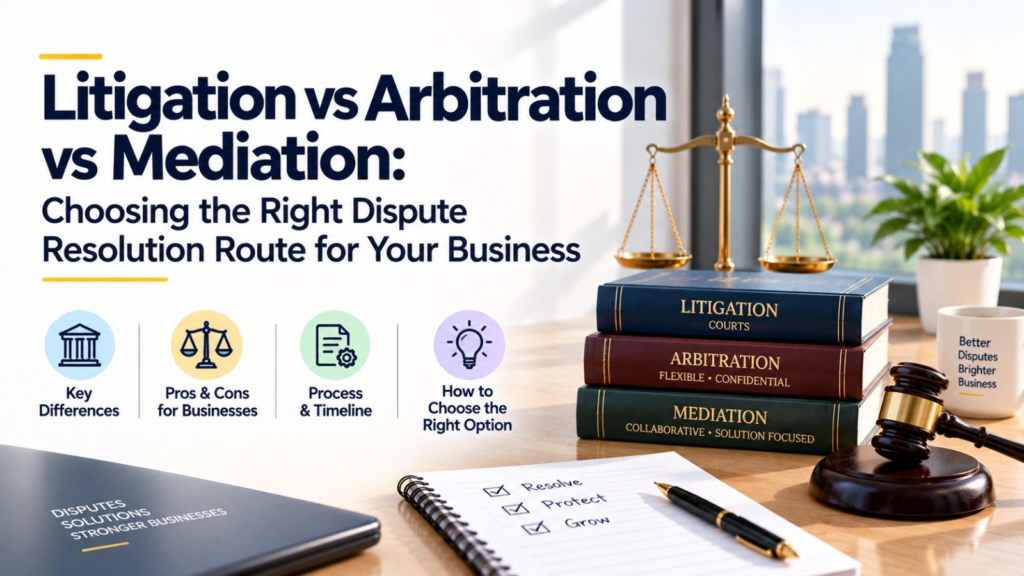
Litigation vs Arbitration vs Mediation are three different ways of resolving a business dispute in India. Each one works differently and has its own advantages and limitations. The right option depends on a majority of factors, and a few of them are listed below:
Common mistake: A lot of business owners make a common mistake where they assume that arbitration is always the fastest and cheapest option compared with litigation. Although it’s true that it can be faster and cost-efficient in a few cases, assuming this is always the case would be wrong. A lot of factors like Arbitrator fees, venue costs, and multiple sittings, etc., can make the overall cost very high, especially in complex disputes. Both parties are typically required to share the arbitrator’s fee, and if one side refuses or fails to pay their portion, the other party often has to cover it just to keep the arbitration moving.
| Factor | Litigation | Arbitration | Mediation |
| Speed | Moderate; 12–24 months in Commercial Courts, longer otherwise | Generally faster; often 10–18 months | Fastest; often weeks to a few months |
| Cost | Court fees + lawyer’s fees; higher for long, contested suits | Arbitrator and venue fees; can rival litigation on complex cases | Lowest; no court fees, shorter engagement |
| Confidentiality | Public record; proceedings and judgment are open | Private by default, subject to contract terms | Private; discussions are typically confidential |
| Enforceability | Court decree, directly enforceable | Arbitral award, enforceable like a decree under the 1996 Act | Settlement agreement, enforceable under the Mediation Act, 2023 |
| Finality/appeal | Full appellate route available | Very limited grounds to challenge an award | No award to appeal; either side can still pursue arbitration or litigation |
Litigation is usually the right call when:
Common mistake: Businesses default to litigation out of habit, even when their contract already has a valid arbitration clause sitting right there. Courts will usually just send you back to arbitration anyway, so you lose time you never needed to lose.
Arbitration usually wins out when:
Meera (illustrative example) runs an IT services firm in Bengaluru. A client dispute over a botched software rollout put ₹1.2 crore on the line. Her services agreement specified arbitration with a technical arbitrator, and the case wrapped up in 14 months, a lot faster than the multi-year timeline a similar dispute would’ve likely taken in a regular civil court.
One drafting mistake that gets expensive fast: confusing the seat of arbitration with the venue. The seat decides which court has supervisory jurisdiction over the arbitration — which courts can hear a challenge to the award, grant interim relief, or set it aside. The venue is simply where hearings physically take place, and it can differ from the seat without changing which court supervises the process. Get this wrong in your arbitration clause, and you can end up fighting in a court you never intended to be under.
If you’re opting for institutional arbitration rather than an ad hoc process, India now has credible options closer to home. The India International Arbitration Centre (IIAC) in New Delhi and the Mumbai Centre for International Arbitration (MCIA) both administer commercial arbitrations, and either can simply be named in your arbitration clause.
Mediation’s genuinely worth trying when:
Common mistake: treating mediation like a box to check instead of an actual negotiation. Walk in with a fixed “we’re not moving” stance, and you’ve pretty much guaranteed it’ll fail, and that means you’ve burned the three-month window for nothing.
Here’s the thing: most disputes get decided before they even happen, by whatever clause got buried in the contract’s boilerplate section. Skip that step, and litigation becomes the default, whether or not it’s actually what suits your business.
A well-drafted clause typically addresses:

The one thing that you should keep in mind is that do not ever choose a generic clause that does not serve any purpose for your specific case. The right way of choosing not only depends on the type of dispute in your business, but also depends on your industry, what your typical contracts are worth, and where your business is functioning- domestic or cross-border counterparties.
Yes, and increasingly, this happens by default rather than by design. If your commercial suit is worth ₹3 lakh or more, Section 12A of the Commercial Courts Act, 2015 already makes you attempt pre-institution mediation before you can even file, unless you genuinely need urgent interim relief. A lot of contracts now build this in on purpose, through a tiered clause:
If mediation works, the settlement is enforceable just like a court decree, under the Mediation Act, 2023. If it doesn’t, you haven’t actually lost anything. The matter just moves on to whichever forum- arbitration or litigation- your contract or the law points you toward next.
One data point worth knowing before you bank on Section 12A working out: a 2023 Economic Advisory Council to the Prime Minister (EAC-PM) working paper studying Mumbai’s two district commercial courts found that between 2020 and 2023, 97–99% of pre-institution mediation applications ended as “non-starters” because the other side simply refused to participate. Of the small share that did engage, roughly half settled — an overall settlement rate of about 1% of all applications filed. The takeaway isn’t that mediation can’t work; it’s that it only works when both sides actually want to be there, which is exactly why willingness, not just compliance, should drive your approach to Section 12A.
Choosing between litigation and the various alternative dispute resolution options in India comes down to a few key factors –
Still not sure? Our dispute resolution advisory services can help you build the right clause in before a dispute ever arises.
For a deeper look at how civil litigation works on its own, see our complete guide to civil litigation for businesses, and if arbitration looks like your route, read more about arbitration as a dispute resolution mechanism.
Business owners often ask a few questions about these dispute resolution methods. Here’s a quick rundown:
In litigation, a case goes to the court of law and a judge makes a ruling. In arbitration, a dispute is settled by a private tribunal based on the contract, and the ruling is nearly final. In mediation, a neutral party (mediator) aids the disputing parties to settle on a resolution.
In general, mediation is the least expensive and time-efficient way to resolve a dispute, followed by arbitration and then litigation.
Yes. Under the Arbitration and Conciliation Act, 1996, a domestic arbitral award is the same as a ruling of a court of law with certain exceptions.
Yes. Generally, for all commercial disputes of more than Rs. 3 lakhs, pre-institution mediation is a required step prior to a filing under Section 12A, except in certain circumstances, including the need for an urgent interim measure.
Mediation and arbitration are more confidential than litigation. Mediation and arbitration are generally more private than litigation. Court proceedings are usually part of a formal judicial process and may involve public records.
A tiered clause — negotiate first, then mediate, then fall back on arbitration or litigation — is the safest default for most business contracts. The exact mix still depends on the value of the contract, the location of the parties, the need for confidentiality, and how much the right to appeal matters to you.
Not quite. Both use a neutral third party, but their roles differ: a mediator mainly facilitates the conversation between the parties, while a conciliator can play a more active role, including suggesting settlement terms. In India, conciliation is also governed under the Arbitration and Conciliation Act, 1996, giving it its own legal identity alongside mediation.
Don’t let the wrong dispute resolution clause cost you months. Partner with Master Brains to get it right.
Call +91-8595867402 or Email to masterbrains.office@gmail.com.
Your business, your time, and your peace of mind matter to us – help is just a call away.
This article is for general informational purposes only and does not constitute legal advice. Which route suits your dispute depends on your contract and specific circumstances, subject to applicable law. Consult a qualified litigation professional before acting on any of the above.
Ministry of Law and Justice, Government of India – Code of Civil Procedure, 1908; Arbitration and Conciliation Act, 1996; Mediation Act, 2023; Commercial Courts Act, 2015; National Legal Services Authority – Pre-Institution Mediation; United Nations Commission on International Trade Law – New York Convention, 1958; India International Arbitration Centre; Mumbai Centre for International Arbitration; Economic Advisory Council to the Prime Minister – Why Commercial Mediation Should be Voluntary (2023).

Master Brains is a consultancy firm based in Delhi having associate partners including Chartered Accountants, Company Secretaries, Cost Accountants, Investment Bankers, Registered Valuers and other consultants in the field of Finance, Tax and Law, PAN India.


Chartered Accountant and Founder of Master Brains. Experience in Direct Taxes (Agarwal Sanjay and Associates, Delhi) and Indirect Taxes (Deloitte India, Bangalore).
LinkedIn Profile