

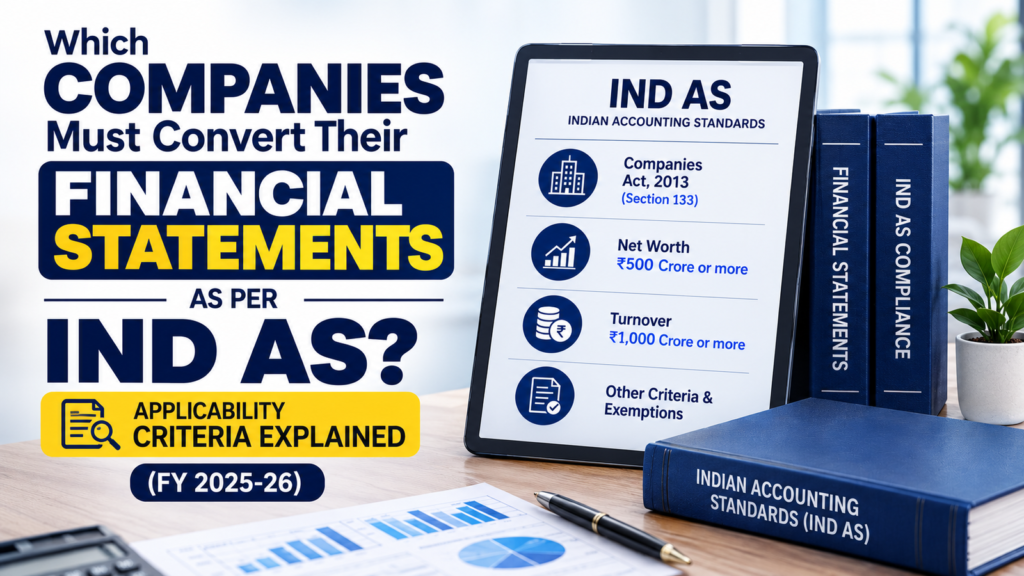
When we think about Indian Accounting Standards (Ind AS), we think it applies to Listed companies only. Not always!
In reality, many unlisted companies are also required to convert their financial statements once they satisfy the applicability criteria.
This Ind AS applicability guide explains which companies are required to adopt Ind AS, the net worth thresholds, group applicability rules and what happens once mandatory Ind AS adoption applies.
Yes. A company must adopt Indian Accounting Standards (Ind AS) if it meets the applicability criteria under the Companies (Indian Accounting Standards) Rules, 2015. Companies covered under Ind AS include listed companies, in process of listing and unlisted companies with a net worth of ₹ 250 crore or more, along with their holding, subsidiary, associate and joint venture companies. It also applies to listed NBFCs or unlisted NBFCs with a net worth of ₹ 250 crore or more, mutual funds and to specified insurance companies from 1 April 2026. Applicability of Ind AS to Banks is deferred.
Indian Accounting Standards (Ind AS) are accounting standards prescribed under Section 133 of the Companies Act, 2013 and notified through the Companies (Indian Accounting Standards) Rules, 2015 by the Ministry of Corporate Affairs (MCA).
They are converged with International Financial Reporting Standards (IFRS).
Companies reporting under Ind AS prepare financial statements in accordance with Division II of Schedule III to the Companies Act, 2013, while Ind AS-compliant NBFCs follow Division III.
Know more in Ultimate Ind AS Guide.
| Company | Requirement to Adopt Ind AS | Effective From |
| Listed companies (or companies in the process of listing equity or debt securities in India or outside India, excluding companies listed on SME Exchanges) with net worth ₹ 500 crores and more | Mandatory | 1 April 2016(Phase 1) |
| All Listed companies (or companies in the process of listing equity or debt securities in India or outside India, excluding companies listed on SME Exchanges) | Mandatory | 1 April 2017(Phase 2) |
| Unlisted companies having net worth of ₹ 500 crore or more | Mandatory | 1 April 2016(Phase 1) |
| Unlisted companies having net worth of ₹ 250 crore or more | Mandatory | 1 April 2017(Phase 2) |
| Holding, subsidiary, associate and joint venture companies of the above entities | Mandatory | – |
| NBFCs having net worth of ₹ 500 crore or more | Mandatory | 1 April 2018(Phase 1) |
| Listed NBFCs (or in the process of listing) below ₹ 500 crore and unlisted NBFCs having net worth of ₹ 250 crore or more | Mandatory | 1 April 2019(Phase 2) |
| Insurance companies | Mandatory for specified co. | 1 April 2026 |
| Mutual Funds | Mandatory | 1 April 2023 |
| Banking companies | Deferred | – |
MCA introduced the mandatory Ind AS adoption roadmap in phases as follows:
Mandatory for:
Mandatory for:
Listed includes equity or debt securities listed or in the process of listing for Ind AS applicability.
Ind AS implementation roadmap for NBFCs was:
Mandatory for:
Mandatory for:
Voluntary adoption by NBFCs is not allowed.
An NBFC subsidiary, associate or joint venture of an Ind AS-compliant non-NBFC parent shall continue Indian GAAP unless separately covered under NBFC Ind AS criteria. Conversely, if an Ind AS-compliant NBFC is the Parent, its non-NBFC subsidiaries/associates/JVs must adopt Ind AS.
IRDAI has notified the Ind AS implementation roadmap for insurance companies (via circular IRDAI/IFRS/CIR/MISC/45/4/2026) from 1 April 2026.
Ind AS applies to:
The IRDAI roadmap also provides a one-year forbearance for eligible insurers along with parallel reporting. Ind AS 117 is a new insurance accounting standard in India.
RBI originally proposed implementing Ind AS for scheduled commercial banks from 1 April 2018. However, the implementation has been deferred and no revised mandatory date has been notified.
Until then, banks continue under the RBI-prescribed accounting framework.
Mutual funds are required to prepare their financial statements using Ind AS. SEBI issued the Guidelines on Accounting with respect to Ind AS through its SEBI circular dated 4 February 2022, requiring mutual fund schemes to adopt Ind AS from 1 April 2023.
Net worth follows the definition in Section 2(57) of the Companies Act, 2013:
Net worth = Paid-up share capital + all reserves created out of profits + securities premium account − accumulated losses − deferred expenditure not written off − miscellaneous expenditure not written off
Net worth for Ind AS applicability excludes:
Net worth is determined based on the audited standalone financial statements as at 31st March of the immediately preceding financial year. If the company’s net worth crosses the threshold in those audited financial statements, Ind AS becomes applicable from the following financial year.
Example: If an unlisted company’s audited standalone financial statements as at 31 March 2026 show a net worth exceeding ₹ 250 crore, Ind AS will become applicable from FY 2026-27 with comparative financial statements that must also be prepared for FY 2025-26 with an opening Ind AS balance sheet as at 1st April 2025.
Once a company is covered under Ind AS, the requirement ordinarily extends to its (except foreign companies):
This applies irrespective of whether those entities independently satisfy the net worth threshold.
ABC Limited is an unlisted company with a net worth of ₹ 320 crore and is therefore required to adopt Ind AS.
ABC Limited owns 100% of XYZ Private Limited, whose net worth is only ₹ 18 crore.
Although XYZ Private Limited does not independently meet the ₹ 250 crore threshold, it must also prepare financial statements under Ind AS because it is a subsidiary of an Ind AS company. The same rule generally applies to holding, associate and joint venture companies of ABC Limited.
Foreign companies are not directly governed by the Companies (Indian Accounting Standards) Rules, 2015 (unless they are incorporated under the Companies Act in India). However, overseas holding companies, subsidiaries or other group entities may need to provide financial information to the Indian group company in a format compatible with Ind AS for group consolidation.
Many companies realise they should have adopted Ind AS only after it’s too late.
Our Ind AS Consultancy Services can help you be ahead with Ind AS compliance.
Which Entities Are Not Required to Adopt Ind AS?
A company that is not mandatorily covered under the notified roadmap can voluntarily adopt Ind AS.
A few reasons for voluntary adoption of Ind AS can be:
Once adopted, the company must continue reporting under the Ind AS framework in subsequent years. Voluntary adoption is not allowed for NBFCs.
Ind AS 101 First-time Adoption of Indian Accounting Standards provides the framework that every first-time adopter must follow to transition from previous Indian GAAP to Ind AS.
Under Ind AS 101, first-time adopters must prepare an opening Ind AS Balance Sheet at the beginning of the earliest comparative period (1 year) {transition date}. This serves as the starting point for all future Ind AS financial statements.
It involves applying the mandatory exceptions and optional exemptions on assets and liabilities under Ind AS 101. It may also involve fair value measurements and support from Valuation Services for determining asset and liability values.
The first Ind AS financial statements must include comparative financial information (preceding 1 year) prepared in accordance with Ind AS by restating the previous year’s financial statements.
This is the most time-consuming aspect of an Ind AS implementation, especially with multiple subsidiaries and complex financial instruments.

Indian GAAP to Ind AS Conversion Process
The process starts with understanding the company’s business model, transactions and group structure to determine Ind AS applicability, transition date and reporting requirements.
Existing accounting policies and financial practices are reviewed against Ind AS requirements. This assessment identifies conversion areas, including financial instruments, leases (Ind AS 116 foundation & Ind AS 116 accounting), revenue recognition (Ind AS 115), fixed assets and deferred tax.
Calculations, supporting documents and management assumptions are reviewed to measure the impact on assets, liabilities, profit and equity.
Based on the impact assessment, Ind AS transition entries are prepared. The company’s opening balance sheet is converted as per Ind AS 101, including consideration of exemptions and exceptions.
Prepare the first Ind AS financial statements as per Division II of Schedule III to the Companies Act, 2013 (NBFCs-Division III).
Audit support is provided for conversion and the company completes implementation of the transition to Ind AS.
Yes. Under the Companies (Filing of Documents and Forms in Extensible Business Reporting Language) Rules, 2015, the moment a company becomes subject to Ind AS, it automatically attracts a mandatory obligation to file its annual financial statements in XBRL format via Form AOC-4 XBRL.
Ind AS is converged with IFRS but is not identical. Certain “Carve Ins” “Carve-outs” are modified by the MCA and ICAI to suit local business, tax and economic realities of India.
Examples of IFRS carve ins include- Ind AS mandates recognition of dividends declared after the reporting period as a liability, reflecting a legal obligation under Indian law that IFRS does not impose. And examples of carve out include differences in the treatment of bargain purchase gains in business combinations (Ind AS 103), Loan Covenant Breach (Ind AS 1), classification of foreign currency convertible bonds (Ind AS 32), etc.
When a corporate restructuring occurs, the resulting or transferee entity must adopt Ind AS if any entity involved in the merger or demerger was already applying Ind AS prior to the transaction.
If restructuring occurs between non-Ind AS entities, the newly formed or surviving company must calculate its combined net worth if it reaches ₹ 250 crore or more, Ind AS applies immediately. Additionally, if a non-Ind AS company becomes a holding, subsidiary, associate or joint venture of an Ind AS entity post-restructuring, it is automatically brought under mandatory Ind AS compliance.
Ind AS became mandatory in two phases. From 1 April 2016, it applied to listed and unlisted companies with a net worth of ₹ 500 crore or more. From 1 April 2017, it was extended to all listed companies and unlisted companies with a net worth of ₹ 250 crore or more.
Net worth is tested for Ind AS applicability based on the audited standalone financial statements of the company, not consolidated financial statements. Companies consider the audited standalone financial statements as at 31 March of the immediately preceding financial year.
No. Once a company adopts Ind AS, whether mandatorily or voluntarily, it is required to continue reporting under Ind AS. Reverting to Indian GAAP is not permitted.
Yes. When Ind AS becomes applicable to a company, the requirement extends to its holding, subsidiary, associate and joint venture companies, even if those entities do not independently meet the net worth threshold.
A first-time Ind AS conversion is governed by Ind AS 101. It involves preparing an Opening Ind AS Balance Sheet, identifying differences between Indian GAAP and Ind AS, restating comparative financial statements, updating accounting policies and preparing the first Ind AS-compliant financial statements.
Yes. Private limited companies must adopt Ind AS if the net worth is ₹ 250 crore or more or they are a holding, subsidiary, associate or joint venture of an Ind AS company. Read more about our Company Law Consultancy Services.
An Indian GAAP to Ind AS conversion can take 4 to 6 months and extends based on the size and complexity of the organisation. At Master Brains, our Ind AS consultants provide Ind AS conversion support, including applicability assessment, accounting adjustments, financial statement conversion, and implementation assistance.
Failure to adopt Ind AS when it is mandatory can result in non-compliant financial statements, audit qualifications, regulatory scrutiny and issues in statutory filings, fundraising or lending.
At Master Brains, our Chartered Accountants assist companies with end-to-end Indian GAAP to Ind AS conversion, including Ind AS applicability assessments, preparing Opening Ind AS Balance Sheet, Ind AS implementation, Ind AS compliance, Ind AS 101 implementation, Schedule III financial statements and audit coordination.
We help businesses achieve Ind AS-compliant financial reporting with minimal disruption.
Call: +91 8595867402
Email: masterbrains.office@gmail.com
References
Reviewed by CA Neha Agarwal, FCA

Master Brains is a consultancy firm based in Delhi having associate partners including Chartered Accountants, Company Secretaries, Cost Accountants, Investment Bankers, Registered Valuers and other consultants in the field of Finance, Tax and Law, PAN India.


Chartered Accountant and Founder of Master Brains. Experience in Direct Taxes (Agarwal Sanjay and Associates, Delhi) and Indirect Taxes (Deloitte India, Bangalore).
LinkedIn Profile