

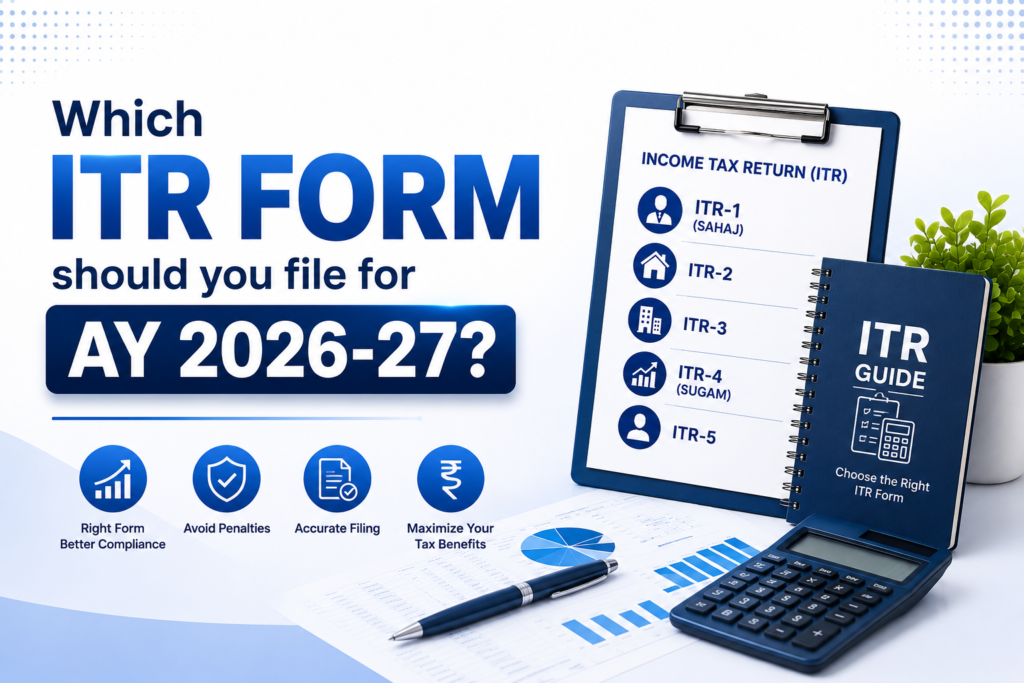
To choose the correct ITR form for AY 2026-27, identify:
Generally:
Always verify the latest Income Tax Department eligibility criteria before filing, as selecting the wrong ITR form may lead to a defective return or delayed processing.
If you’re wondering which ITR form to file for AY 2026-27, the answer depends on several factors, including your income sources, residential status, taxpayer category, and whether you earn salary, business income, capital gains, or foreign income. The Income Tax Department has notified seven different ITR forms, each designed for a specific category of taxpayers.
Before diving into the detailed eligibility criteria, here’s a quick overview to help you identify the form that most likely applies to your situation.
| If you are… | Generally File |
| Salaried employee with eligible income | ITR-1 (Sahaj) |
| Salaried individual with capital gains, multiple house properties, or foreign assets | ITR-2 |
| Freelancer, consultant, trader, or proprietor maintaining books of accounts | ITR-3 |
| Small business owner or professional opting for presumptive taxation | ITR-4 (Sugam) |
| Partnership Firm, LLP, AOP or BOI | ITR-5 |
| Company | ITR-6 |
| Trusts and exempt institutions | ITR-7 |
Choosing the correct return form is the first step toward hassle-free income tax filing. However, before selecting your form, it’s equally important to understand its specific purpose. Grasping this basic purpose before diving into detailed eligibility criteria makes it much easier to identify the one that’s right for you.
The Income Tax Department has notified seven different ITR forms (ITR-1 to ITR-7) to accommodate the diverse income profiles of taxpayers in India. Instead of having one universal return form, each form is tailored to a specific category based on factors such as:
ITR-1 (Sahaj): Best for Salaried Individuals with Simple Income Choose ITR-1 if you’re a resident individual earning salary or pension income, income from eligible house property(ies), and other sources like bank interest, while meeting the prescribed eligibility conditions.
ITR-2: For Investors, NRIs & Individuals with Complex Income If your income goes beyond a regular salary, such as capital gains from shares or mutual funds, foreign assets, or higher-value investments, ITR-2 is generally the correct form.
ITR-3: For Business Owners and Freelancers Choose ITR-3 if you earn income from a business or profession and are required to compute profits under the regular provisions of the Income Tax Act.
ITR-4 (Sugam): For Presumptive Taxation If you’ve opted for the presumptive taxation scheme under Sections 44AD, 44ADA, or 44AE and satisfy the prescribed conditions, ITR-4 simplifies the filing process.
ITR-5, ITR-6 & ITR-7: For Businesses, Companies and Trusts The remaining ITR forms are meant for specific entities rather than individual taxpayers.
| Form | Generally Filed By |
| ITR-5 | Partnership Firms, LLPs, AOPs, BOIs and similar entities |
| ITR-6 | Companies (other than those claiming exemption under Section 11) |
| ITR-7 | Trusts, charitable institutions, political parties and other exempt entities |
If you’re filing as an individual, you can usually focus on ITR-1 to ITR-4, as these cover the majority of taxpayers. However, before selecting your form, it’s equally important to understand the latest updates introduced by the CBDT for AY 2026-27. Here are the key updates you need to know:
The new ITR forms for AY 2026-27 include several changes aimed at simplifying compliance while improving reporting accuracy. (For official verification of these changes, taxpayers can refer to the notifications published on the Official Income Tax Department Portal).
1. ITR-1 Now Allows Income from Two House Properties One of the most significant updates this year benefits salaried taxpayers. Previously, individuals owning a second house property generally had to shift from ITR-1 (Sahaj) to the more detailed ITR-2. Under the revised rules for AY 2026-27, eligible taxpayers can now report income from up to two house properties while continuing to file ITR-1, provided they satisfy the other eligibility conditions.
2. Mandatory Secondary Address Disclosure All ITR forms now require taxpayers to provide a secondary address. If both addresses are the same, the filing utility allows you to simply select “Yes,” making the process easier without requiring duplicate entries.
3. Report All Bank Accounts Held During the Financial Year Taxpayers must now disclose all bank accounts held at any point during the financial year, including accounts that were closed during the year. Only officially dormant accounts are excluded from this reporting requirement.
4. Higher Threshold for Asset and Liability Disclosure The reporting threshold for Schedule AL (Assets and Liabilities) has been increased. Detailed disclosure is now required only if your total income exceeds ₹1 crore, reducing the compliance burden for many taxpayers.
5. Simplified Reporting of Certain Capital Gains Another welcome relief is that Long-Term Capital Gains (LTCG) on listed equity shares and equity-oriented mutual funds under Section 112A, up to ₹1.25 lakh, can now be reported through the simpler ITR-1 and ITR-4, subject to the prescribed conditions. (For a deeper dive into how this tax is calculated, read our complete guide on Section 112A and Capital Gains Taxation).
Before submitting your return, remember to reconcile your income with AIS, TIS, and Form 26AS, verify your bank account details, and ensure you’ve selected the correct tax regime wherever applicable. A careful review today can save significant time and effort later.
At Master Brains, our tax professionals assist individuals, professionals, businesses, and NRIs with end-to-end income tax consultancy services, from identifying the correct ITR form to reviewing tax calculations, verifying disclosures, and filing returns accurately and on time.
If your tax situation involves multiple income sources, capital gains, business income, foreign assets, or other complex reporting requirements, seeking professional guidance of Master Brains can help ensure your return is filed accurately and in line with the latest Income Tax Department provisions.
Salaried individuals earning up to ₹50 lakh, with one house property, agricultural income up to ₹5,000, and income from other sources (like interest) should typically file ITR-1 (Sahaj).
Yes, but only if they are Long-Term Capital Gains (LTCG) under Section 112A on listed equity or equity-oriented mutual funds up to ₹1.25 lakh. If you have Short-Term Capital Gains (STCG) or your LTCG exceeds ₹1.25 lakh, you must shift to ITR-2.
If you are a director of a company or hold unlisted equity shares at any time during the financial year, you are strictly disqualified from filing ITR-1 or ITR-4. You must file ITR-2 or ITR-3.
Yes, as a freelancer or small business owner, you can file ITR-4 (Sugam) if you are covered under the presumptive taxation scheme. Under Section 44AD, businesses with gross turnover up to ₹2 crore, or up to ₹3 crore if cash receipts are 5% or less, can file ITR-4. Under Section 44ADA, specified professionals with gross receipts up to ₹50 lakh, or up to ₹75 lakh if cash receipts are 5% or less, can also file ITR-4. Transporters can file under Section 44AE based on a fixed rate per vehicle. If you maintain regular books of accounts and claim actual business expenses, you will need to file ITR-3 instead.
NRIs are not eligible to file ITR-1 or ITR-4. Depending on the nature of their income in India, an NRI should file ITR-2 (if there is no business income) or ITR-3 (if there is business income).
Yes. A major update for AY 2026-27 allows eligible resident individuals to report income from up to two house properties directly in ITR-1. Previously, owning a second property mandated filing ITR-2.
Filing the wrong ITR form renders your return “defective” under Section 139(9) of the Income Tax Act. You will receive a formal notice from the tax department and must file a revised return using the correct form within a stipulated time frame.

Master Brains is a consultancy firm based in Delhi having associate partners including Chartered Accountants, Company Secretaries, Cost Accountants, Investment Bankers, Registered Valuers and other consultants in the field of Finance, Tax and Law, PAN India.


Chartered Accountant and Founder of Master Brains. Experience in Direct Taxes (Agarwal Sanjay and Associates, Delhi) and Indirect Taxes (Deloitte India, Bangalore).
LinkedIn Profile