

The most expensive mistake financially distressed companies make is waiting too long to prepare for IBC resolution and restructuring.
By the time lenders initiate recovery actions, suppliers offer choking credit terms, customers begin questioning continuity and management becomes consumed by thousand challenges. Nonetheless, significant enterprise value may already have been lost.
The solution to this problem is preparation using a complete IBC resolution checklist.
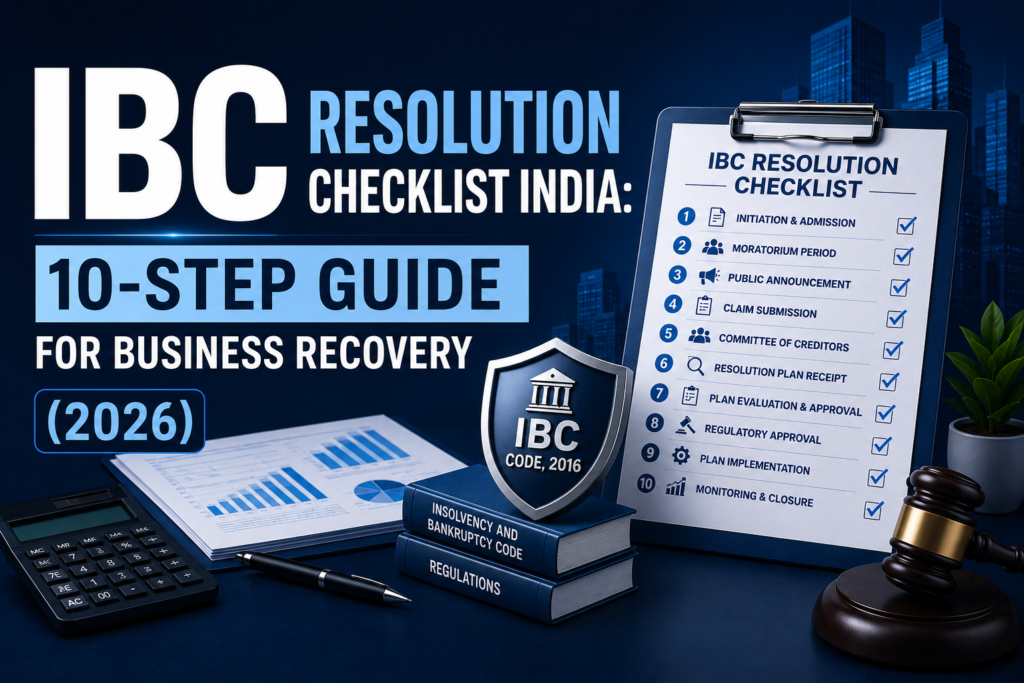
To support this process, this Master Brains guide provides a practical 10-step IBC resolution checklist for CEOs, CFOs, promoters and business leaders preparing for business recovery discussions and potential insolvency proceedings.
The insolvency ecosystem in India operates under a creditor control model once CIRP is admitted under IBC 2016. At this stage, a Resolution Professional (RP) takes control of the company’s management, while creditors collectively evaluate resolution plans submitted by potential investors or acquirers.
As a result, the quality of preparation before entering the resolution process often has a direct impact on the outcome.
Companies with well-prepared corporate turnaround checklist are generally better positioned to preserve value and attract credible resolution applicants.
In distressed situations, value erosion happens faster than most management teams expect. But if they further delay in preparation, there is incremental loss of supplier confidence, asset value and investor interest.
But if companies prepare for IBC resolution, there are chances for the following to happen:
1. Stronger negotiation with creditors
2. Higher confidence among resolution applicants
3. Better business continuity during CIRP
4. More competitive resolution bidding
The IBC framework has also encouraged early settlements. According to IBBI, approximately 30,310 cases involving underlying defaults of ₹ 13.78 lakh crore were settled before admission into the insolvency process.
{Source: Insolvency & Bankruptcy Quarterly Newsletter Jan-Mar 25}
Every successful resolution initiative begins with an honest assessment of financial reality.
The assessment should examine:
| Financial Performance | Debt Position | Liquidity Position | Operational Viability |
| Revenue Trends | Secured Borrowings | Cash Reserves | Capacity Utilization |
| Gross Margins | Unsecured Borrowings | Receivables Collection Cycles | Customer Concentration Risks |
| EBITDA Performance | Working Capital Facilities | Vendor Obligation | Contractual Commitments |
| Cost Structure | Guarantee Obligations | Short-Term Funding Requirements | Market Competitiveness |
A realistic assessment helps to assess whether the business is viable in future under a restructured balance sheet or do the company need a deeper operational solution.
Before moving toward insolvency resolution, management should evaluate whether the business can still recover through restructuring outside formal proceedings. This step is one level deeper.
Management should seek answers to the following questions:
Along with this, the total debt obligations, actions taken by existing lender, recovery proceedings already started and availability of out-of-court restructuring options has to be thoroughly checked.
The most common reason for delays during insolvency proceedings is poor documentation. Before initiating any process, create a centralized document repository containing minimum:
| Financial Records | Corporate Records | Debt Documentation | LegalRecords |
| Audited Financial Statements | Articles And Incorporation Documents | Loan Agreements | Pending Civil & Commercial Litigation Case Files |
| GST Returns & ITR | Shareholding Pattern | HypothecationMortgage Deeds | Regulatory Notices |
| Bank Statements | Board Resolutions | Charge Registration Certificates(Form CHG-1/CHG-4) | Tax Litigation Records (Income Tax Appeals, GST Appeals) |
| Management Reports | Governance Records | Guarantee Records | Arbitration Proceedings & Contract Disputes |
Successful business recovery coincides with complete understanding of stakeholder relationships. Prepare a complete mapping statement of these stakeholders:

Also, try to understand the stakeholder’s priorities. It gives clarity to evaluate various options available.
Cash flow is the deciding factor in resolution and revival. A good comprehensive review of monthly inflows and outflows, receivable aging, inventory cycles, debt servicing commitments and fixed operating costs should be performed to get better picture of cash flows. As a part of resolution building, develop forecasts covering 6 months and 12 months.
This exercise identifies in-depth liquidity risks.
A realistic understanding of business valuation is important for the company, creditors and potential resolution applicants. The valuation service taken in this regard should cover valuation of the tangible assets, financial assets and intangible assets. An independent valuation can reveal hidden opportunities for restructuring and investment. This step strengthens negotiations and supports decisions to be taken.
Compliance issues can complicate insolvency proceedings. It increases cost and creates friction in the process.
Conduct a 360-degree review of the company’s compliance status. It should cover corporate governance, statutory filings, tax matters, labour obligations, environmental approvals and sector-specific regulations. Early identification of compliance gaps reduces execution risk and prevents avoidable delays during the resolution process, keeping everything smooth.
One of the biggest blunder companies make is focusing exclusively on debt resolution. Creditors, investors and resolution applicants are equally interested in understandings how the business will succeed after restructuring.
An effective turnaround strategy considers the following factors:

Some of the turnaround strategies are:
The turnaround plan should demonstrate that the business has a future worth investing in.
Many companies avoid difficult conversations with lenders until relationships have already deteriorated.
It is rightfully said that conversations and communication can make things lighter. A genuine effort towards transparent engagement can rebuild trust, facilitate better negotiations and open the door to restructuring opportunities.
The above pre-IBC assessments are not so easy to conduct. It requires expertise across financial, legal, operational and regulatory matters.
So, companies engage experienced IBC advisors early. They evaluate available options, identify risks, prepare documentation and develop an effective resolution strategy.
Depending on the situation, the advisory team may include insolvency professionals, legal counsel, financial advisors, valuation consultants, income tax advisors and turnaround consultants. Working with the right experts helps management make well-inform decisions and respond effectively to stakeholder concerns throughout the process.
As of March 2026, creditors have recovered around ₹ 4.32 lakh crore through approved resolution plans under the IBC framework. These recoveries are about 116.85% of the liquidation value and nearly 94.56% of the fair value of the assets, reflecting strong value preservation under the insolvency process.
~ as per Press Release “India’s Insolvency Framework”
The first step in the IBC resolution checklist is conducting a financial distress assessment. This helps evaluate debt obligations, liquidity issues and business viability and is essential to prepare for IBC resolution in a structured way.
Eligibility for IBC initiation depends on the existence of a default under the Insolvency and Bankruptcy Code, 2016. A creditor or company can file once a debt of at least ₹ 1 crore is unpaid. Supporting documents like loan records, invoices and default proof are required and disputes may affect filing.
The main documents include financial statements, debt records, bank statements, asset registers, creditor lists, compliance reports and legal documents. These form an important corporate turnaround checklist for IBC processing.
Generally, IBC resolution can take 6-12 months. These timelines vary depending on case complexity, litigation and stakeholder coordination. Proper preparation under the IBC resolution checklist helps improve efficiency in insolvency resolution steps in India.
Yes. During CIRP, the business may continue operations while a resolution plan is developed, supporting value preservation in stressed asset resolution India.
A Resolution Professional manages the entire insolvency process, oversees operations, verifies claims and evaluates resolution plans, ensuring proper execution of corporate turnaround checklist requirements.
Every distressed situation is different, but IBC preparation almost always improves the quality of outcomes. A structured approach helps management stay clearer, act earlier and respond better when pressure builds.
In most cases, the difference between value preservation and value erosion is simply timing and readiness.

Master Brains is a consultancy firm based in Delhi having associate partners including Chartered Accountants, Company Secretaries, Cost Accountants, Investment Bankers, Registered Valuers and other consultants in the field of Finance, Tax and Law, PAN India.


Chartered Accountant and Founder of Master Brains. Experience in Direct Taxes (Agarwal Sanjay and Associates, Delhi) and Indirect Taxes (Deloitte India, Bangalore).
LinkedIn Profile