

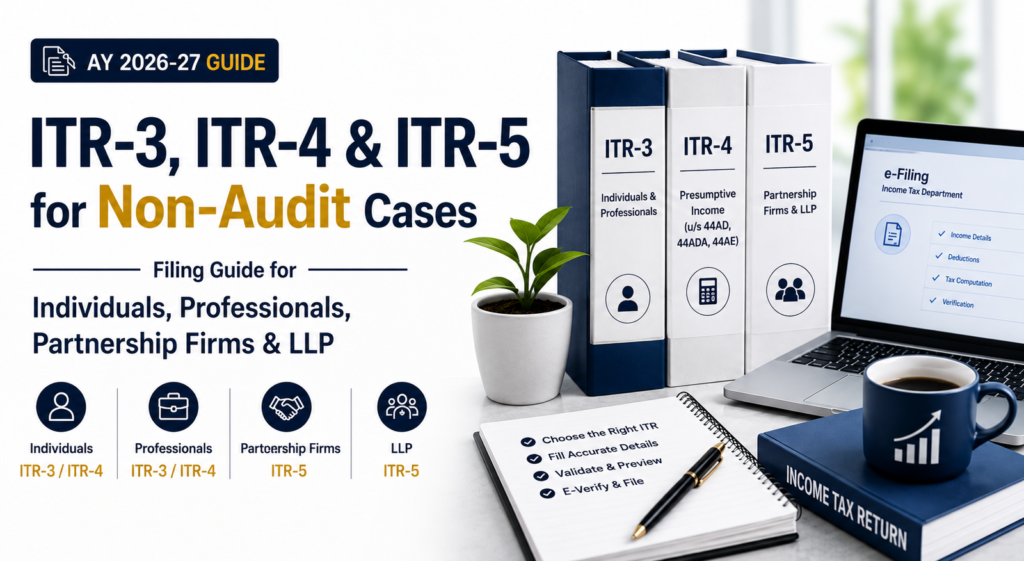
Once you know your business doesn’t need a tax audit, the hard part should be over. But ITR filing is still left. One ITR filing mistake – picking the wrong form or misreporting one line item – can put you in a spiral of income tax notices and intimations.
This ITR filing guide talks about how to choose the correct ITR form for AY 2026-27, reporting requirements for ITR-3, ITR-4 and ITR-5, business and profession pre-filing reconciliation and complete non-audit return before 31 August 2026.
Audited vs. Non-Audited Status: This article assumes you have already confirmed your non-audit status.
31 August 2026 is the statutory due date under Section 139(1) for filing ITR-3, ITR-4 and ITR-5 returns for non-audit taxpayers in AY 2026-27. The Finance Act, 2026 inserted a dedicated deadline of 31 August for non-audit taxpayers deriving profits and gains from a business or profession.
Primary sources: Income tax department – Return of Income, ITD – FAQ
| STATUTORY FILING TIMELINE(AY 2026-27) | |||
| ↓ | ↓ | ↓ | ↓ |
| 31 JULY 2026 | 31 AUGUST 2026 | 31 OCTOBER 2026 | 30 NOVEMBER 2026 |
| Salaried/Non-Business | Non-Audit Business/Profession | Tax Audit Cases | Transfer Pricing Cases |
(ITR-1 & ITR-2) | (ITR-3, 4, 5) | (ITR-3,5,6) | (ITR-5, 6) |
Choosing the correct Income Tax Return form depends primarily on who you are, the nature of your income and whether you have opted for presumptive taxation.
For non-audit cases, tThe table below answers your question: Should I file ITR-3, ITR-4 or ITR-5?
| Taxpayer | Nature of Income | Applicable ITR | Due Date (AY 2026-27) |
| Individual/HUF | Regular Business/Profession (Maintaining regular books of account & non audit) | ITR-3 | 31 August 2026 |
| Individual/HUF | Presumptive business or professional income under Sec. 44AD, 44ADA or 44AE | ITR-4(Sugam) | 31 August 2026 |
| Partnership Firm(not LLP) | Presumptive Business Income (Sec. 44AD, 44ADA or 44AE) | ITR-4(Sugam) | 31 August 2026 |
| Partnership Firm(not LLP) | Business income (non-audit) | ITR-5 | 31 August 2026 |
| LLP (not liable to audit) | Business or professional income(Presumptive/Regular) | ITR-5 | 31 August 2026 |
The simplest way to understand the difference is:
ITR-4 (Sugam): It is designed for eligible Resident taxpayers like Individuals, HUFs and Partnership Firms (excluding LLPs) whose total income does not exceed ₹ 50 Lakhs and having business or professional income under the presumptive tax schemes of Section 44AD, 44ADA or 44AE. For AY 2026-27, ITR-4 can also accommodate only Section 112A LTCG up to ₹ 1.25 lakh.
ITR-3: A form required for individuals and HUFs earning income under the head Profits and Gains of Business or Profession (PGBP) who are not eligible for ITR-4 (Sugam).
Eligibility, Turnover & Filing under 44AD and 44ADA: All about Presumptive Taxation Scheme
| ITR Form | Eligibility | Income Type | Due Date for AY 2026-27 |
| ITR-3 | Individuals and HUFs who have income from PGBP and are not eligible to file ITR-1, ITR-2 or ITR-4 | Salary/Pension, House Property, Business or Profession, Capital Gains or other sources | 31 August 2026 |
| ITR-4 (Sugam) | Resident Individuals (not RNOR), HUFs and Partnership Firms (not LLPs) eligible under presumptive taxation | Presumptive business or professional income under Sections 44AD, 44ADA or 44AE | 31 August 2026 |
| ITR-5 | Partnership Firms, LLPs, AOP & BOI | Business or professional income, capital gains, house property & other sources | 31 August 2026 |
The five-assessment-year restriction is specifically related with Section 44AD(4) of the Income tax Act.
Where an eligible assessee has declared profits under Section 44AD and subsequently opts out of presumptive taxation scheme of Section 44AD and declares profits normally, then the taxpayer cannot claim the presumptive benefit for the next five assessment years.
This also has implications for books and audit requirements in cases covered by Section 44AD(5).
Section 44AD and Section 44ADA should be analysed separately. Professionals (like doctors, lawyers or consultants) do not have a 5-year lock-in period.
Section 115BAC Default Tax Regime & Form 10-IEA Rules (AY 2026-27)
The New Tax Regime under Section 115BAC is the default regime for AY 2026-27.
Taxpayers having business or professional income who want to opt out of the default New Tax Regime must furnish Form 10-IEA on or before the due date under Section 139(1) (31 August 2026 for non-audit cases).
Unlike taxpayers without business or professional income, they cannot freely switch between the Old and New Tax Regime every year. After opting for the Old Tax Regime, they have a one-time option in a subsequent assessment year to withdraw that option and re-enter the New Tax Regime. Once they re-enter the New Tax Regime, they cannot opt for the Old Tax Regime again.
ITR Filing for Freelancers and Consultants & Small Business Owners
ITR-3 Practical Reporting
Some of the important reporting areas file ITR with multiple income sources are:
Regular Books: Report the accounting profit or loss, cost of goods sold, administrative overheads, deductions required to arrive at taxable business/professional income. You would need detailed financial statement figures to report in Schedule BP.
No Regular Books Maintained (Exempt under Section 44AA): You would need to enter only a few financial statement figures like Gross Receipts & Gross Profit, etc.
Section 40(a)(ia): Add back 30% of payments made to residents where TDS was not deducted or deposited by the due date of filing the return.
Section 40A(3): 100% of expenditure exceeding ₹ 10,000 paid other than prescribed modes is disallowed, subject to some exceptions.
Important fields in the form are:
Capital account balances must reconcile mathematically.
Closing Capital = Opening Capital + Net Profit – Drawings
You have to report capital gain by disclosing full value of consideration, asset acquisition costs, improvement costs and indexed acquisition costs.
Report every transfer of Virtual Digital Assets with Date of Acquisition and Date of Transfer, Cost of Acquisition, Consideration Received. Losses from VDAs cannot be set off against any other income or carried forward. Know TAXATION OF VIRTUAL DIGITAL ASSETS.
It is mandatory for resident taxpayers (ROR). Report foreign bank accounts, depository accounts, equity/custodial accounts, immovable property or signing authority, etc. held outside India.
Failure to disclose foreign assets in Schedule FA attracts penalties under the Black Money Act, 2015 (a flat penalty of ₹ 10 Lakhs). However, if the total aggregate value of foreign assets (other than immovable property) does not exceed ₹ 20 Lakhs in case of non-reporting, Schedule FA will not attract the ₹ 10 Lakh penalty.
You have to report gross receipts into two buckets:
The turnover limit is ₹ 3 Crores, provided total cash receipts do not exceed 5% of aggregate turnover.
Disclose gross professional fees and minimum deemed taxable profit at 50%.
The gross receipts limit is ₹ 75 Lakhs, provided cash collections do not exceed 5% of total professional receipts.
Please report vehicle registration details, tonnage capacity and ownership duration.
Though full financial statements are not required, ITR-4 filers must report these four balance sheet figures as of 31 March 2026:
You are required to report turnover or gross receipts declared in the GST returns.
In ITR-5, a partnership firm or LLP should review areas:
Report net profit or loss as per the Profit & Loss Account, expenses disallowable under Income tax law, depreciation and the taxable profit or business loss.
Deductions for partner remuneration and interest paid to partners under Schedule BP, strictly governed by the statutory income tax limits under Section 40(b).
This schedule is specific and relevant where the ITR-5 filer (individuals and entities) is itself a partner in one or more other firms. This section requires details such as:
Partner interest and remuneration are deductible only if authorised by the partnership deed/LLP agreement and within Section 40(b) limits.
An LLP is required to have its accounts audited under the Limited Liability Partnership Act, 2008 if its turnover exceeds ₹ 40 Lakhs or its partner capital contributions exceed ₹ 25 Lakhs.
Tax audit applies to LLP under Section 44AB of the Income tax law if turnover thresholds are crossed (like for regular business – ₹ 1 Crore or up to ₹ 10 Crores if cash transactions do not exceed 5%. For profession – gross receipts exceed ₹ 50 lakh in the financial year).
An LLP that is exempt from Tax Audit but required to get statutory audit under the LLP Act, must file its ITR-5 by the extended deadline of 31 October 2026 (not the standard 31 August 2026).
Match the TDS shown in Form 26AS/AIS/TIS with your records and ITR. Check credits under sections such as 194C (contractors), 194J (professional/technical fees), 194H (commission) and 194O (e-commerce payments).
Match your books and bank statements with the income reported in the ITR. Check that all business/professional receipts, interest, commission and other income have been properly considered.
Make sure the turnover reported in ITR-3, ITR-4 or ITR-5 is consistent with GST returns (GSTR-1 and GSTR-3B), wherever business is GST registered. Investigate and explain any material differences to reduce risk of income reporting mismatches.
File ITR-4 (Sugam) if you meet the eligibility criteria for presumptive taxation under Section 44AD, 44ADA or 44AE, your gross receipts remain within income tax law limits (up to ₹ 3 Crores for business, ₹ 75 Lakhs for profession in case of at least 95% non-cash receipts) and your total income is under ₹ 50 Lakhs.
File ITR-3 where you are not eligible for ITR-4. File ITR-3 if you maintain regular books of account, claim actual profit lower than the minimum as per presumptive scheme, hold foreign assets, earn capital gains, serve as a company director, hold unlisted shares or need to carry forward losses.
Non-audit Partnership Firms can file ITR-4 if they qualify for and opt into presumptive taxation under Section 44AD, 44ADA & 44AE. Otherwise, partnership firms must file ITR-5.
LLPs are prohibited from filing ITR-4 and must file ITR-5 for any amount of income, regardless of whether they choose regular or presumptive bookkeeping.
If an assessee has declared profits under Section 44AD and during the next five-year period does not declare profits in accordance with Section 44AD(1), Section 44AD(4) applies. This clause says that the assessee cannot claim Section 44AD for the five assessment years from the year of opting out of presumptive scheme.
During this period, if the assessee’s total income exceeds the basic exemption limit, they have to comply with maintenance of books under Section 44AA(2) and tax audit under Section 44AB if liable.
Regarding ITR form selection, ITR-4 cannot be used by an individual or HUF carrying on business in such cases. ITR-3 would be appropriate.
The last date to file ITR for non-audit individuals, professionals, firms and LLPs for FY 2025-26 is 31 August 2026.
If you miss the deadline, you can file a Belated Return under Section 139(4) by 31 December 2026. Consequences of late ITR filing include late filing fees under Section 234F (₹ 1,000/₹ 5,000), interest under Section 234A, inability to validly opt for the Old Tax Regime via Form 10-IEA and loss of carry forward business and capital losses rights under Section 80.
Yes. Master Brains provides end-to-end tax advisory, tax compliance and income tax return filing services for sole proprietors, professionals, partnership firms and LLPs. Our income tax return filing consultants manage your AIS/TIS reconciliation, tax regime optimization (Old vs New), Form 10-IEA submissions, partner remuneration calculations under Section 40(b) and submission of ITR-3, ITR-4 and ITR-5 returns.
This is only one part of filing a return. The real work is calculating the numbers, form and tax position right before ITR submission.
Master Brains’ CAs can help Iincome Ttax clients with:
Explore Our Services: ITR Filing for Businesses, Professionals, Firms & LLPs
Direct Call: +91 85958 67402
Email ID: masterbrains.office@gmail.com
This guide will be updated if CBDT issues any further extension.

Master Brains is a consultancy firm based in Delhi having associate partners including Chartered Accountants, Company Secretaries, Cost Accountants, Investment Bankers, Registered Valuers and other consultants in the field of Finance, Tax and Law, PAN India.


Chartered Accountant and Founder of Master Brains. Experience in Direct Taxes (Agarwal Sanjay and Associates, Delhi) and Indirect Taxes (Deloitte India, Bangalore).
LinkedIn Profile